At the beginning of May 2026, B-Cubed partners gathered in Montpellier, France, for our final meeting to discuss the key results of the project and the last steps to be undertaken before B-Cubed’s end in August 2026. The Final meeting coincided with the first European Conference for Biodiversity Monitoring (BioMonWeek2026), giving us the chance to present our results to a broader audience and set the stage for their use in future biodiversity monitoring efforts.
Final B-Cubed Meeting
Our final in-person meeting focused on our four case studies, which test the performance of B-Cubed’s tools and indicators.
- Our stakeholder-driven case study focuses on optimising the top-down and bottom-up assessment and reporting under the Habitat Directive by enhancing GBIF data integration.
- The case study on biological invasions in Flanders tests GBIF workflows on trends in regulated species, invasive species pressure in protected areas, and phylogenetic diversity mapping
- The case study on South Africa’s national indicator framework for biological invasions uses B-Cubed data cubes, indicators and research done throughout the project for revising South Africa’s bioinvasion status.
- Our case study on RAMSAR sites explores the status and trends of biodiversity in the study areas, compares them, and assesses the feasibility of calculating biodiversity trends with sites of varying area sizes, data availability and location worldwide.
In the second part of the meeting, we combined forces with partners from the MAMBO Project, which also had its final General Assembly, and discussed how to advance the results of each of the projects after they finish in August 2026. In the end, we outlined some newly-started and upcoming EU projects and initiatives (such as BEAGLE, NextBON, TETTRIX, OneSTOP Project, Biodiversity Meets Data, Bon-in-a-Box, GeoPl@ntNet, and CamAlien) which step upon the results of B-Cubed and MAMBO and can help advance them after both projects finish in August 2026.
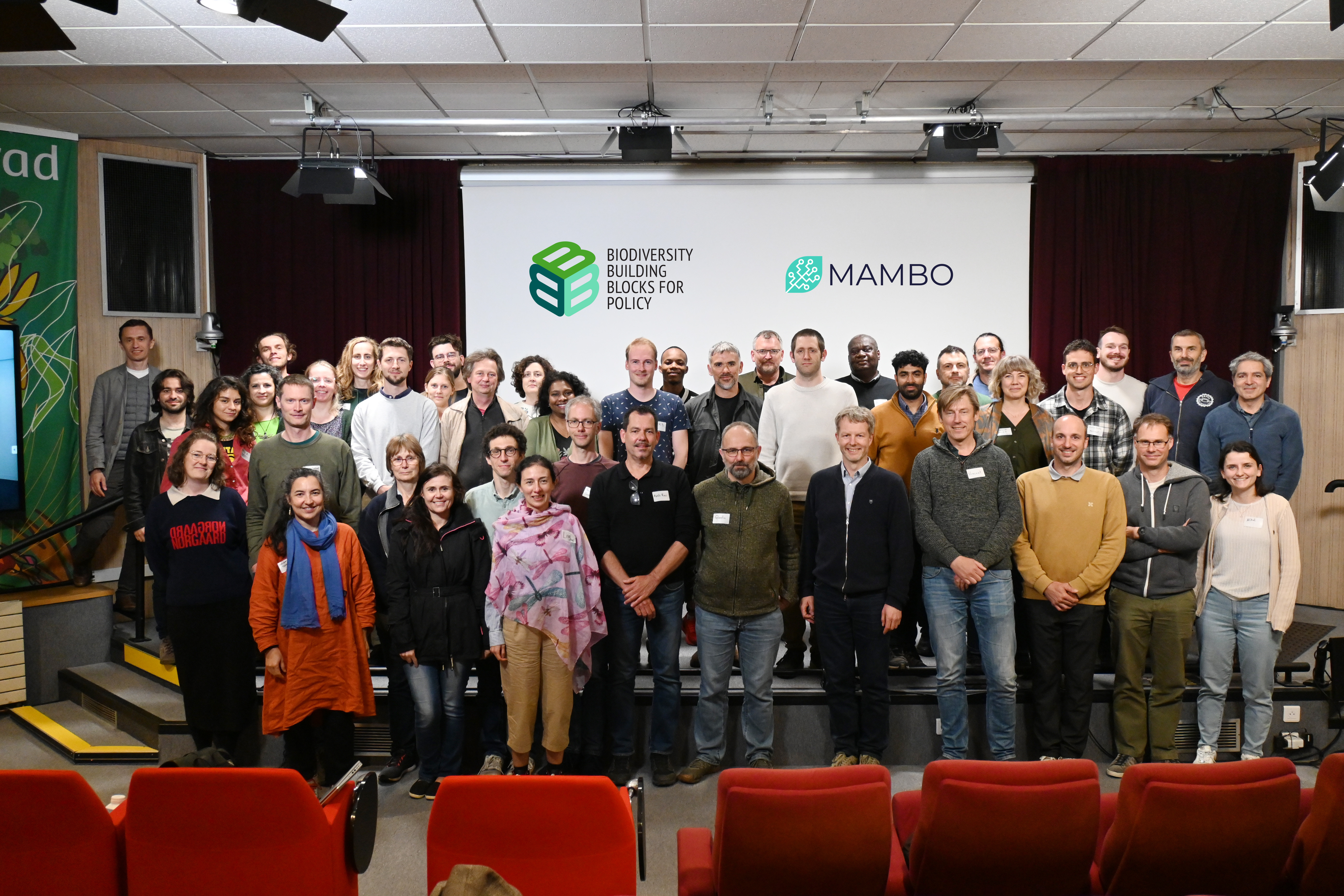 B-Cubed partners at the final B-Cubed Meeting
BioMonWeek2026
After our Final Meeting, we stayed in Montpellier until 8 May to contribute to the first European Conference for Biodiversity Monitoring (BioMonWeek2026). The event featured plenary keynotes and panels, including topics on different aspects of biodiversity monitoring (i.e terrestrial, marine, freshwater and mass monitoring, as well as data management, public policy and funding for monitoring, etc)
During the event, B-Cubed was presented at a joint booth with the Global Biodiversity Information Facility (GBIF), where visitors learned more about the project and its activities and had the chance to get materials, such as our legacy booklet and policy briefs.
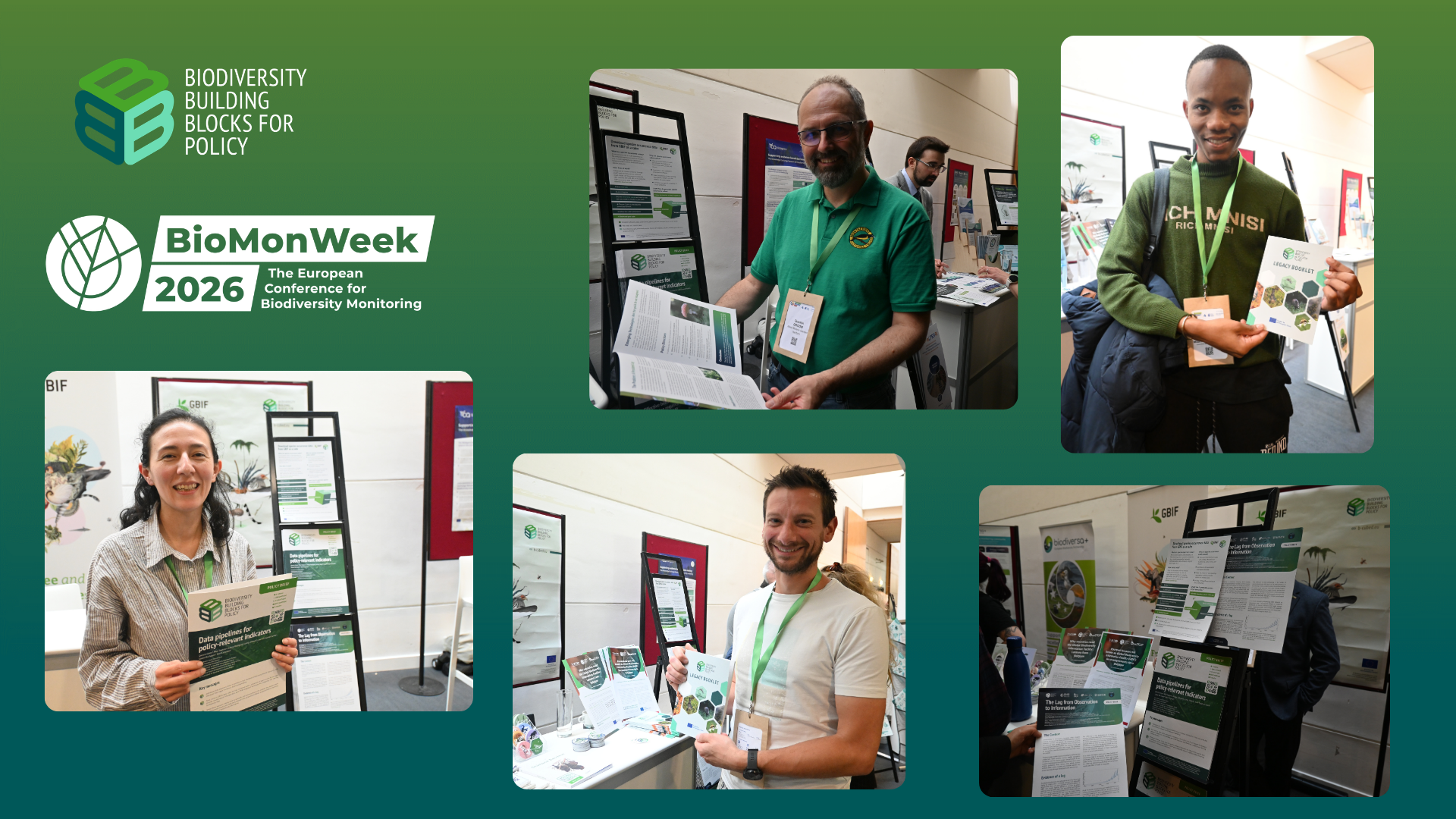 Photos from B-Cubed's participation in BioMonWeek2026
In addition, B-Cubed contributed to several sessions focused on biodiversity data management and using data cubes:
-
Data Workflows and Pipelines for WorkFlowHub: Sandra MacFadyen (Stellenbosch University) showed how a reproducible workflow architecture for biodiversity monitoring can turn scattered records into indicators, enabling policymaking. After her, Andrew Rodrigues (GBIF) explained how GBIF species occurrence cubes help bridge the gap between large-scale biodiversity data infrastructures and operational biodiversity monitoring and reporting.
-
Novel RS approaches. Data Integration and Systems: In another session, Maarten Trekels (Meise Botanic Garden) explained how extending data cube dimensions using multi-spectral imagery can form a solid and reproducible basis for species distribution analysis.
-
Policy implementation to bridge the gap from data to action: Louise Hendrickx (Meise Botanic Garden) presented our latest joint policy-brief with OneSTOP project on how current implementations of the One Health framework remain “plant-blind” and how this affects food system resilience, ecosystem stability, and microbiome interactions.
-
Poster session: Lissa Brugelmans (Meise Botanic Garden) presented her poster on pdindicatoR, an R package for calculating phylogenetic diversity indicators from GBIF species occurrence cubes.
-
Biodiversity Data Cubes: This cube dedicated session featuring presentations by Lina Estupinan Surarez (MLU), Ward Langeraert (INBO) and Ana Luisa Machado (University of Aveiro) They showcased key aspects of the project such as how biodiversity data cubes are operationalised for open science and informed policy, allowing efficient data aggregation and harmonizing multiple data sources using the b3gbi R Package, creating reproducible workflows to integrate EU Habitats Directive reporting with GBIF data, and transforming heterogeneous biodiversity data, such as GBIF occurrence records, into standardised occurrence cubes and policy-relevant indicators using the b3verse.