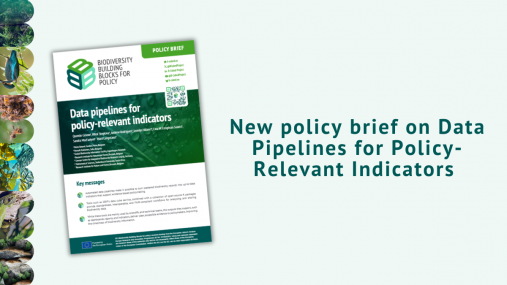
Although large volumes of biodiversity data are available, they are often fragmented, inconsistent, and difficult to integrate efficiently, which poses a challenge for policy-makers. B-Cubed’s new policy brief outlines how automated, interoperable data pipelines can streamline this process.
Automated data pipelines make it possible to turn scattered biodiversity records into indicators that support evidence-based policymaking. The process begins by creating occurrence cubes using the GBIF SQL service. These cubes allow for the derivation of indicators that distil complex data into meaningful measures of biodiversity status and trends. In addition, three modelled cubes (Suitability cube, Invasibility cube and Dissimilarity cube) extend the indicator framework by targeting different, complementary aspects of biodiversity dynamics.
By combining data cubes with a collection of open-source R packages, B-Cubed demonstrates how standardised workflows can deliver repeatable metrics on biodiversity status and trends, including general and phylogenetic indicators, invasive-species impacts, and uncertainty estimates. This further strengthens the evidence base for policy frameworks such as the EU Green Deal, the Habitats and Birds Directives, and Kunming-Montreal Global Biodiversity Targets under the Sustainable Development Goals.
While the tools developed are mainly used by scientific and technical teams, their policy value lies in shortening the time between data collection and decision-ready evidence. As indicators can be recalculated with the arrival of new records, reporting can reflect better current conditions, early-warning signals can be detected sooner, and interventions can be evaluated more consistently over time. Consequently, the infrastructures and workflows described establish a scalable foundation for turning biodiversity data into real-world insights by developing standardised data products, reproducible indicator calculations, and mechanisms for publication and reuse through platforms such as the EBV Data Portal.
Read policy brief here.