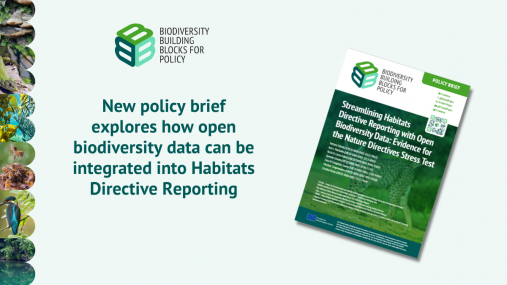
B-Cubed has published a policy brief with the findings of our case study, exploring the integration of open biodiversity data into the species-level assessment of the Habitats Directive Article 17 reporting. The brief builds upon stakeholder consultations and was submitted as evidence to the Commission's Stress test of Birds and Habitats Directives.
European Union (EU) Member States are required to publish regular reports under Article 17 of the EU Habitats Directive. They use the same reporting framework, but reporting remains inconsistent as national monitoring programmes differ in spatial coverage, methodology and taxonomic scope. At the same time, the Global Biodiversity Information Facility (GBIF) aggregates millions of species occurrence records from monitoring programmes, citizen science initiatives, research projects and museum collections. While complementary, these data remain largely untapped in formal Article 17 reporting workflows.
In view of these challenges, B-Cubed has been developing tools to help integrate open biodiversity data from GBIF into Habitats Directive policy workflows. The project’s new policy brief shows that while GBIF holds more than two decades of relevant occurrence records, in each reporting cycle nearly a third of Habitats Directive species had no data available in GBIF. Part of that gap is taxonomic: many taxa listed at sub-species level regionally do not appear as such in GBIF, where occurrences are often recorded at species level.
Practice varies considerably. Some Member States integrate GBIF records into their national workflows while others rely only on national monitoring data, and none use open data exclusively. Among those that do use it, GBIF serves as a complementary source alongside closed monitoring programmes rather than a replacement for existing reporting systems.
The study identified two main barriers to integrating GBIF data into Article 17 reporting: concerns about data quality and trust, particularly whether opportunistic occurrence records are suitable for regulatory assessments; and limited awareness of what data available through GBIF could contribute to national reporting. Stakeholders not already using these data also tended to see GBIF as a single source rather than a large number of separate datasets, each with its own quality control and scope.
Key opportunities and recommendations
Drawing on consultations with stakeholders, the policy brief identifies several opportunities:
-
Improving technical interoperability between GBIF data infrastructures and national reporting systems;
-
Building institutional capacity and guidance to support the appropriate use of open biodiversity data in Article 17 reporting;
-
Strengthening coordination at European level, with EEA and DG ENV playing a role in promoting harmonised approaches, sharing best practices and supporting cross-Member State learning;
-
Enhancing the role of GBIF National Nodes as technical support hubs connecting biodiversity infrastructures with national policy needs;
-
Going beyond statistical uncertainty to evidence stability, B-Cubed complements uncertainty estimates by assessing whether conclusions remain robust to changes in data, assumptions and analytical choices.
Based on these, B-Cubed formulated three different sets of recommendations for 1) Member States, 2) EEA and DG Environment and 3) GBIF (Secretariat and National Nodes) and other Research Infrastructures.
Access them all in the full policy brief: https://zenodo.org/records/21994699