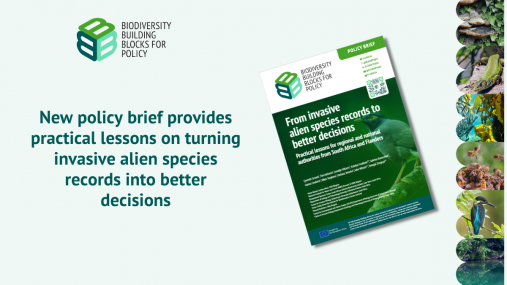
B-Cubed’s latest policy brief provides practical lessons for regional and national authorities on turning invasive alien species records into better decisions. The brief builds on our case studies in South Africa and Flanders and outlines what is needed in an invasive alien species information system and where most existing systems typically break.
The two case studies differ greatly in size, biodiversity, demography, institutional frameworks and data availability; however, they both conclude that better invasive alien species information depends on the organisation, publication and maintenance of data.
Currently, much of the information that authorities responsible for biological invasions need to know already exists – for example, which alien species are present, where they occur, whether they are spreading, what their impact is and whether management is working. However, such information is fragmented across different sources that are not always compliant with the FAIR principles or regularly updated. This leads to the evidence base being reconstructed from scratch each time the authorities need to assess or report on the status of biological invasions, and often causes substantial delays.
B-Cubed’s case studies explored how this issue could be solved using the tools developed by the project. The South African case study shows how standardised species lists, repeatable workflows and a clear reporting framework strengthen national assessments of biological invasions. The Flanders case study shows how openly published occurrence data can be transformed into maps and indicators. Regional and national authorities do not need to build the necessary infrastructure from scratch. Existing services such as GBIF provide shared standards, data-publishing infrastructure, persistent identifiers and tools for processing biodiversity data, and these can be connected to national species lists, monitoring programmes and reporting systems to produce information tailored to regional and national needs.
The policy brief defines the starting point as organising existing resources around the decisions they need to support and identifies seven areas where regional and national authorities can act:
-
Building the information system around decisions, which can be done by first agreeing which management questions it must answer and identifying the minimum data needed for each indicator
-
Maintaining an authoritative and living species list, with clear institutional responsibility and procedures for submitting evidence, reviewing changes and publishing updated versions
-
Making data publication part of monitoring, so that publicly funded surveillance and research programmes include publication in their work plans, budgets and deliverables, and publish regularly rather than only at the end of a project or reporting cycle
-
Using repeatable, documented workflows instead of rebuilding assessments each cycle, retaining source data, scope, filtering rules, analysis code and a record of changes from the previous version
-
Publishing data quality alongside ecological results, including recording intensity, coverage, publication delays, completeness and uncertainty — since more observations need not mean more invasive species
-
Using data gaps to direct surveillance, with a regular surveillance-gap assessment produced alongside the ecological assessment
-
Integrating outputs into established information services, so that new workflows feed existing species portals, biodiversity information systems and reporting processes — with project dashboards treated as prototypes unless an institution, budget and technical plan for their long-term maintenance is agreed
The brief concludes that the aim is to create a dependable flow of evidence from observation to publication, assessment and action, and provides a seven-step practical programme for regional and national authorities.
Learn more about all the steps in the full policy brief: https://zenodo.org/records/21977633