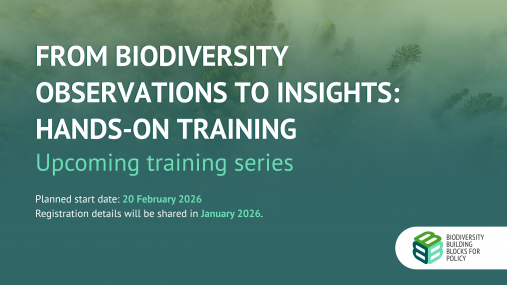
Turning raw biodiversity records into policy-relevant indicators remains challenging, as the growing volume of data is often fragmented, inconsistent, and difficult to integrate effectively. B-Cubed’s upcoming training series will showcase emerging approaches that help make data more actionable in practice.
The series will feature six live sessions, held on six consecutive Fridays at 15:00 CET. Each session will last 1.5 hours, combining a presentation, Q&A, and a hands-on segment where participants try out tools and workflows, making for an enjoyable Friday afternoon.
📅 Planned start date: 20 February 2026
📌 Registration details will be shared in January 2026.
📝 While the full agenda is still to be confirmed, the series will include:
-
Creating species occurrence cubes with GBIF: An introduction to GBIF’s new, easy-to-use service for creating and downloading species occurrence cubes from GBIF-mediated data using SQL queries, illustrated with practical examples.
-
Using occurrence cubes for Kunming-Montreal Global Biodiversity Framework Target 6 indicators: A session exploring how occurrence cubes can support Target 6 indicators and biological invasions research.
-
Indicators for national invasion reporting: Insights from South Africa’s national reports on the status and management of biological invasions. This session will cover the reporting process, how it has evolved over time, and key lessons learned and challenges encountered.
-
Automating biodiversity turnover mapping with dissmapr: Using butterfly assemblages across South Africa as a case study, the session will demonstrate how dissmapr generates turnover heatmaps and bioregional maps that support scalable, evidence-based biodiversity management and conservation planning.
-
Using occurrence cubes for indicators: This training session will show how biodiversity data cubes can be used to derive indicators that summarise complex data into measures of biodiversity status and trends.
More details soon!